To import heavy machinery to Venezuela, start by classifying the equipment. A truck or tractor may fall under vehicle rules, while a backhoe or harvester will usually follow the machinery chapter. The code determines age limits, taxes, permits and possible benefits.
Before you buy, review the spec sheet, intended use, year, weight and dimensions. This guide separates the rules for cargo vehicles, heavy machinery and agricultural machinery so you can make the decision with verifiable information.
Machinery, tractors and cargo vehicles are not the same
Venezuelan regulation separates this equipment into categories with different treatment:
- Tractors and cargo vehicles: tractors and many trucks or tractor units fall within Chapter 87. Certain used units may be subject to age limits and exclusions by subheading. Calling a unit "a truck" is not enough: the code and the current rule must be confirmed before buying.
- Heavy and agricultural machinery: backhoes, forklifts, cranes, harvesters and other equipment are often classified under Chapter 84, depending on their function and features. That chapter does not have a general age limit equivalent to the vehicle rule.
- Self-propelled or special-purpose equipment: wheels or an engine do not determine the code by themselves. Function, design and legal notes may lead to a different classification.
The customs broker analyzes the information and prepares and supports the proposed classification. The Customs Administration makes the determination with official validity. To understand how the code is built, read our guide to tariff classification in Venezuela.
What to review before buying
Collect this information before you pay or book the shipment:
- Make, model, year and serial number.
- Spec sheet and exact function of the equipment.
- New or used condition.
- Shipping weight and dimensions, including accessories or detached parts.
- Propulsion type, tires or tracks.
- Photographs and, when available, a drawing with support or lifting points.
- Country of origin and intended use in Venezuela.
These details make it possible to review the code, the age rule when applicable, the legal regimes and the shipping mode. A description such as "heavy machinery" is not enough for an accurate quote.
Documents for the quote, customs declaration and later procedures
To prepare a complete quote, UNICA requests five documents: commercial invoice, packing list, BL, ocean freight value and spec sheet. If you do not have all of them yet, we can give you initial guidance on WhatsApp before you buy.
For the customs declaration, the commercial invoice, transport document and importer documents are reviewed together with any permit, license or certificate required by the code. A certificate of origin is not universal: it is presented when required by the origin, an agreement, a benefit or the applicable regime. Used equipment may also require a title or other proof of ownership.
What must be confirmed with the INTT
A cargo vehicle or tractor that must be registered may require registration and homologation procedures with the INTT, Venezuela's land transport authority. For Chapter 84 machinery, the INTT has used the Special Registry for Agricultural and Heavy Machinery, known as REMAP, but the current procedure must be confirmed for the unit and its intended use.
If the equipment will travel by road on a platform or lowboy, the carrier must confirm the authorization that applies to its fleet, the equipment and the route. The INTT portal lists the relevant road circulation permits. Do not assume that the same permit applies to every operation.
Tariff, VAT and exemptions: what is actually verified
Productive machinery is not automatically a capital good (BK) and does not automatically qualify for an exemption. Treatment is determined by the exact code and the rules in force when the declaration is registered.
- Some goods identified as BK or BIT may qualify for special tariff treatment when they meet the current conditions and obtain the corresponding certificate.
- Agricultural machinery and spare parts may have specific treatment, but it should not be assumed to apply automatically. The code, condition of the goods and benefit available on the declaration date must be confirmed.
- Other import benefits depend on whether the code appears in a current appendix and whether its legal regimes are met.
Temporary benefits may be amended or expire. They must be checked again when the operation is prepared, and the decision for each unit requires its specification sheet, tariff code and the rules then in force.
How machinery travels: RORO, flat rack and breakbulk
Machinery does not always fit in a container, and the shipping mode also affects cost:
- RORO (roll-on, roll-off): the unit moves on and off through ramps, under its own power or towed, if accepted by the carrier. It is often used for trucks and wheeled machinery.
- Flat rack: a container base without side walls or a roof. It works for equipment that does not fit in a closed container, provided it can be supported and secured within the accepted limits.
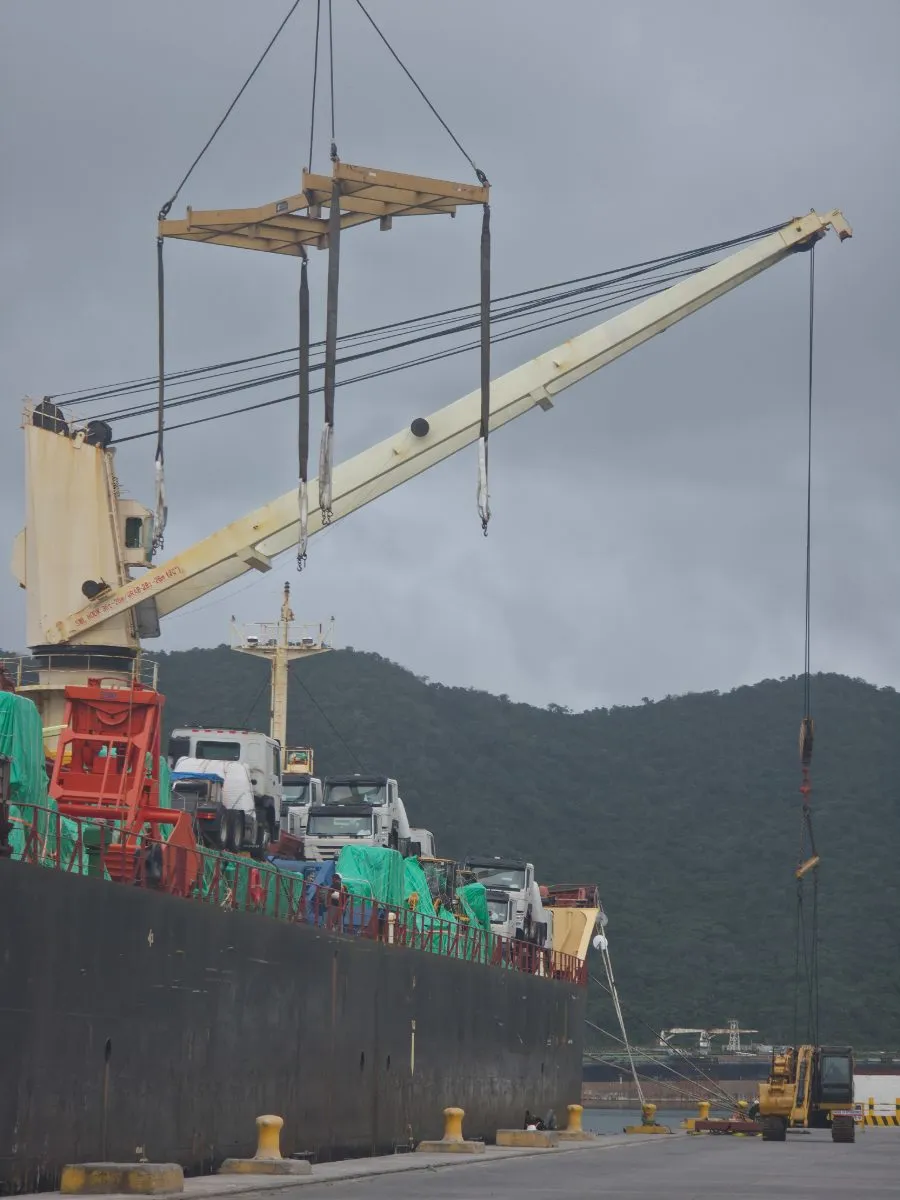
- Breakbulk: the equipment is handled as a non-containerized piece, using a crane or the ship's gear and a specific stowage and securing plan.
Each mode has its own freight cost, port handling, lashing and insurance requirements. A specification sheet with exact weight and dimensions is needed to evaluate the appropriate shipping mode.
If the equipment exceeds standard dimensions, travels in separate pieces or arrives in several shipments, the operation may qualify as project cargo and requires different planning. We explain it in the guide on how to import project cargo to Venezuela.
The costly mistakes we see at the port
- Misclassifying the equipment. A wrong code can change the taxes, permits, allowed age and benefits that might be requested.
- Buying a used vehicle without checking the subheading. Certain tractors and cargo vehicles are subject to age conditions and exceptions. The review must be completed before payment.
- Ignoring the dimensions. A unit that exceeds the measurements changes its freight mode and its cost. That is calculated before buying, not at the port.
- Assuming every unit uses the same INTT procedure. Registration, homologation and transport authorization depend on the type of unit, its use and how it will move.
- Counting on an exemption before it is granted. Productive use does not prove that equipment is BK or that COMEX will grant the benefit.
Verify before buying: how we work at UNICA
We have more than 20 years managing customs operations through Venezuelan ports. With heavy equipment, our approach is to review the operation before shipment.
- You write to us on WhatsApp with the spec sheet and the equipment details before you buy.
- We prepare the proposed classification and review the age rule, legal regimes and possible benefits for that code.
- We prepare your free personalized quote using the five documents. You receive it the same business day when the information is complete.
- We manage the customs declaration and clearance and coordinate the documents with the carrier, terminal and inland transporter. Each party remains responsible for its physical operation.
We explain the full customs process in our guide on what a customs broker does. Are you evaluating a piece of equipment? Request a review of your import, with no obligation.
Frequently asked questions
How do you export heavy machinery to Venezuela from another country?
For the seller in the country of origin, the equipment leaves as an export. When it enters Venezuela, it is processed as an import and its classification, technical sheet, permits, customs value and registration requirements are reviewed.
UNICA handles review and customs clearance in Venezuela. The export declaration and origin-country formalities remain the responsibility of the supplier and the authorized operators in that country.
What are the requirements to import heavy machinery to Venezuela?
You need to identify the equipment with its spec sheet, use, year, serial number, weight and dimensions. For the quote, we review the invoice, packing list, BL, freight value and spec sheet. Permits, the certificate of origin and INTT procedures are confirmed according to the code and unit type.
What is the tariff to import machinery?
It depends on the tariff code, customs value and any benefit that is in force and has been granted. That is why we do not give generic percentages: we first review the spec sheet and exact code, then prepare the quote.
Which imports do not pay taxes in Venezuela?
There is no safe answer based only on a product name. A code included in a current appendix or identified as BK or BIT may receive a full or partial benefit if it meets the conditions and obtains the corresponding certificate. It must be confirmed for the specific goods and date.
Can I import used machinery with no age limit?
Machinery and cargo vehicles do not follow a single age rule. The classification, subheading and current conditions must be confirmed before buying.
Do trucks pay the same taxes as cars?
Not necessarily. Trucks have their own codes and tariff rates. Customs value is determined under valuation rules using the invoice and supporting documents, subject to the authority's verification. The SIDUNEA reference used for certain vehicles should not be extended automatically to all machinery or trucks.
Do I need a customs broker to import machinery?
As a general rule, customs declarations and procedures are completed through an authorized customs broker. The broker reviews the documents, prepares the proposed classification, files the declaration and assists during customs inspection. The authority keeps the official decision, while logistics operators perform transport, lifting and physical handling. Read what a customs broker does in Venezuela.
Does your company need to import machinery or cargo vehicles? Request a review of your operation and we will answer within the same business day.